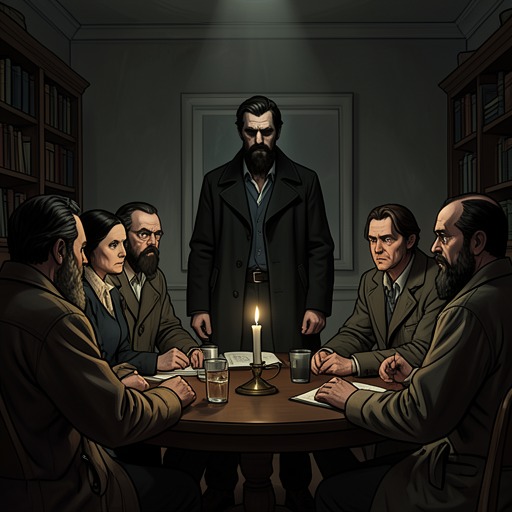
The Transformation of the State into the Church
The Brothers KaramazovThe Transformation of the State into the Church is Ivan Karamazov’s vision of a future in which the relation between religious and political authority is reversed: the Church does not settle for a subordinate place inside the State; the State itself is transformed until it becomes the Church. The proposal is both institutional and moral. It rejects compromise over jurisdiction as a false settlement and imagines that a society shaped by the Church would eventually alter its understanding of crime, judgment, and punishment.
The argument against compromise
Ivan presents his position during the family gathering at the monastery, in a discussion that turns on the relation between Church and State. He begins from the expectation that their elements will remain confused, even though they cannot truly be joined. Such confusion, he argues, cannot produce consistent or normal results because falsity lies at its foundation. In particular, he regards compromise on jurisdiction not as a workable division of responsibilities but as an attempt to reconcile principles that are fundamentally incompatible.
The disagreement concerns more than how much public influence the Church should possess. Ivan’s clerical opponent, Father Paissy, maintains that the Church already has a precise, defined position within the State. Ivan rejects this arrangement. He objects to treating the Church as one social organization among others, assigned a limited place within a political order whose terms it does not determine. His challenge therefore shifts the question from the Church’s permitted jurisdiction to the State’s ultimate purpose.
Ivan speaks with composure and cordiality as he explains the argument, a manner that gives the dispute the form of a considered intellectual exchange rather than an outburst. Father Paissy, however, stresses the implications of the claim, returning to Ivan’s words and asking the gathering to hear what they commit him to. Their exchange makes the theory’s central tension visible: the Church’s spiritual vocation is presented not as one interest to be accommodated within the existing State, but as a principle that would eventually reorganize the State as a whole.
Early Christianity and the future ideal
Ivan supports his position by referring to Christianity’s beginnings. During the first three centuries, he argues, Christianity existed on earth only in the Church and was nothing but the Church. When the pagan Roman Empire sought to become Christian, the relation between the two institutions could not simply remain a matter of arranging a stable place for the Church inside the old political structure. Ivan reads the historical movement in the opposite direction: the world, including the ancient pagan State, is to be drawn into the Church.
That account of the past becomes a forecast. The Church should not seek a defined position in the State, as though it were merely a religious association operating within a political framework. Instead, every earthly State should ultimately be transformed into the Church and become nothing else. The distinction between a Church that occupies a corner of public life and a State that has become wholly Church is the argument’s decisive reversal. Political society is not to remain an independent authority that grants religion a place; it is to be remade according to the Church’s vocation.
Ivan frames the proposal as a future aspiration rather than a description of an existing system. He acknowledges the pressure of modern European arrangements, under which the Church may be allotted a limited, controlled position in the State. Against that prospect, he sets Russian hopes and conceptions: not a transition by which the Church passes into a higher kind of State, but the transformation of the State until it is worthy to become only the Church. The ideal thus depends on a change in the political order itself, not merely on a stronger institutional presence for clergy.
Crime, judgment, and punishment
The discussion turns from constitutional principles to criminal justice. Father Paissy draws out what the Church’s expanded authority might imply: whether the Church would try criminals and sentence them to corporal punishment, imprisonment, or even death. His question exposes a practical anxiety within the ideal. If Church and State are no longer separate, the proposal cannot be treated as a purely abstract statement about religious influence; it raises the issue of who judges wrongdoing and what penalties that authority may impose.
Ivan replies that, if there were only an ecclesiastical court, the Church would not sentence a criminal to prison or death, even in the present. He further argues that crime itself, and the way society regards crime, would inevitably change, although not all at once. In his account, the transformation of institutions would be inseparable from a transformation in moral understanding. The Church’s authority would not simply administer the same punitive system under a religious name; its presence would alter how wrongdoing is understood and answered.
The exchange leaves the ideal’s scope clear while keeping its practical consequences open to dispute. Ivan asserts that the Church would not impose the most severe secular penalties, and that society’s conception of crime would change over time. The conversation does not provide a detailed replacement legal code or a step-by-step political program. Its force lies instead in the direction of change it proposes: jurisdictional compromise gives way to a transformed social order, and criminal judgment becomes one test of whether that order would act according to the Church’s different conception of its vocation.
Significance within the debate
The transformation ideal brings institutional design and religious purpose into a single argument. Ivan does not call for the Church merely to gain greater influence in a State that remains otherwise intact. He reverses the conventional hierarchy: the State is the provisional form, and the Church is the end toward which it should be transformed. His appeal to the first centuries of Christianity supplies the historical premise; his forecast of a changed attitude toward crime supplies one concrete consequence.
The discussion also distinguishes Ivan’s claim from Father Paissy’s concern about the powers a Church court might exercise. The question is not only whether ecclesiastical authorities would punish, but whether the social order’s understanding of crime would itself change. Ivan answers by denying that a Church court would sentence offenders to prison or death and by predicting a gradual transformation in how crime is regarded. The ideal therefore sets a demanding standard for the Church’s public role: it must not simply reproduce the State’s existing machinery of coercion under different supervision.
As an argument in the novel’s debate, the proposal remains a vision articulated and contested in conversation, not an enacted constitutional settlement. Its significance rests in the scale of its reversal and in the challenge it poses to any easy division of religious and political authority. By insisting that the State should become the Church rather than the Church become a managed part of the State, Ivan makes the future character of society—and the treatment of those who break its laws—the central measure of the claim.